
Compare the Value Types on a Bonner County Record
A Bonner County property value can mean several things. It may be the Assessor's current market estimate. It may be a taxable or net figure after exemptions. Or it may simply be the consideration named in a recorded deed. Each term answers a different question. A buyer should never swap one for another just because all three sit on the same parcel record.
| Value | What It Is | Where |
|---|---|---|
| Current market or assessed value | The county's annual valuation basis before reductions | Assessor notice and tax record |
| Taxable or net market value | The displayed value after an eligible exemption or reduction | Treasurer sample bill |
| Recorded sale consideration | Transfer evidence in the deed, which may not equal open-market price | Recorder instrument |
| Land and improvements | Separate parts that add to the total county valuation | Assessor and sample bill |
Idaho's assessment ratio divides assessed value by sale price. The state uses it for equalization analysis. It is not a guaranteed discount on any one parcel. Instead, the county Assessor sets current market value each year, drawing on cost data, recent sales, site visits, and information from market participants.
Bonner County Separates Land and Improvement Value
The official redacted tax bill shows property location, legal description, parcel number, land value, improvements, total market value, homeowner exemption, and net market value. That layout does real work. It lets a reader see whether a change came from land, from a building, or from a reduction.
The bill also keeps owner mailing and situs addresses apart. Neither address changes the meaning of the value fields. Neither proves who occupies the land, either.
Bonner County Assessment Ratios Are Study Tools
State ratio studies compare assessments against market evidence. Their purpose is to test assessment levels across the county. They cannot prove that every Bonner County property value sits a set percentage below sale price. Applying a countywide ratio to one house hides condition, date, location, and classification differences. For the county number, use the parcel's own notice. For a date-specific market opinion, use a qualified appraisal.
Look Up a Bonner County Property Value
Start with an address. Then save the full parcel number, because it is the stable cross-reference across GIS, assessment, and tax materials. The simplified Bonner County Property Search is reference material, and its annual-update caution matters whenever a recent change is under review.
- Find the address and parcel in the county property-search or public GIS route.
- Record the valuation year, land, improvements, total market, exemption, and net figure actually shown.
- Check the recorded deed separately if sale consideration is relevant; no public Assessor last-sale-price field was confirmed.
- Preserve the source date and ask the Assessor about an unexplained classification or value change.
- Assessed value
- The county valuation used as the basis before applicable reductions.
- Market value
- The Assessor's annual estimate, distinct from a private appraisal.
- Assessment ratio
- A study comparison of assessed value with sale evidence.
- Reassessment
- The recurring process of reviewing current market value.
Bonner County Revalues Property Each Year
The Assessor states that current market value is determined annually. Even so, the simplified search warns that certain events may lag. A classification change, mobile-home conversion, split or combine, or dwelling added in 2025 may not appear there. That means it may not show until December 2026. The operational GIS can refresh more often. That gap is a local records quirk, not a contradiction. When citing a Bonner County property value, note which display supplied it and when.
Recorded Sale Evidence Is a Separate Bonner County Stream
A recorded deed may state consideration. But the public Recorder index is organized by names and dates, not parcels. The simplified Assessor page publishes no last-sale-price field. So do not expect one. Use EagleWeb to locate the transfer instrument, then read its terms and legal description. A non-market transfer, family conveyance, or partial interest can make consideration a poor estimate of present value.
Splits and Mobile Homes Can Delay a Bonner Value Display
The annual page names several events that can stall a value display. Splits and combines take processing time. So does a newly added dwelling. Classification changes and conversion of a mobile home to real property also take time. Two official screens may appear out of step meanwhile.
During a split, search the parent parcel and keep the assessment notice. For a mobile home, confirm how the county classes it. Is it personal or real property? Compare values only after that.
Bonner County's 2026 Notice Cycle Shows Why Dates Matter
The Assessor announced 2026 assessment notices by June 1. The inquiry period ran through June 22. A statewide error also affected some business-personal-property notices, and the office said corrected notices would be mailed. A corrected figure should replace the earlier one in any comparison. The official assessment page supplies the current process context.
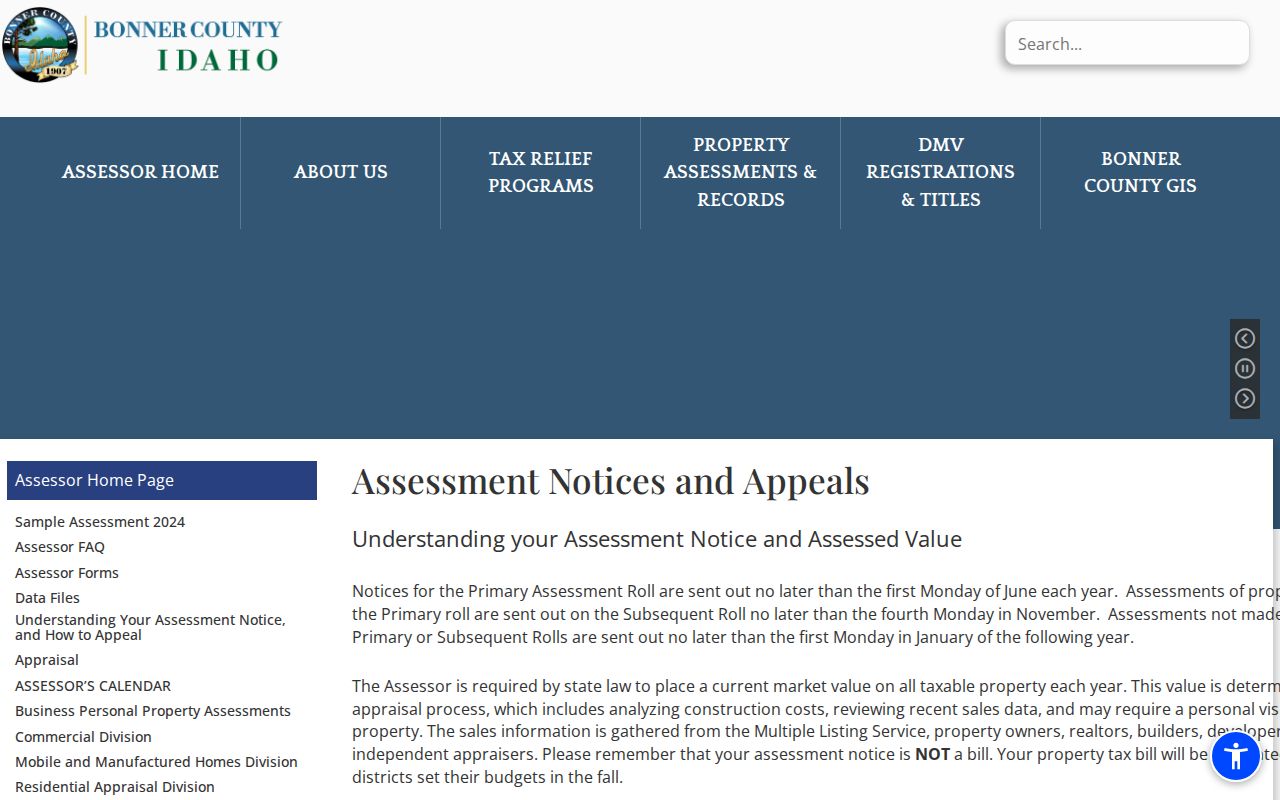
This image documents the county valuation source, not a live parcel detail or appraisal.
What a Bonner County Assessed Value Cannot Tell You
An assessed value is a mass-appraisal result built for taxation. It cannot price every condition. It cannot capture private terms, repairs, a view, or a transaction at the moment a reader checks the record. A city median is only broad context, never evidence for one parcel.
Value versus price. A Bonner County assessed value is not a promise of sale price and is not an appraisal. Obtain a qualified, date-specific opinion when one is needed.
Tax levies drive the bill, not the market price. The Bonner County property tax page covers payment, exemption, and appeal mechanics without changing what the value number itself means.
Match Bonner County Value Evidence to the Question
Each evidence stream has its own job. Annual assessment explains the county's tax basis and lets you compare the same labeled field over time. A recorded transfer adds transaction evidence. A private appraisal gives a professional opinion pinned to one date. Repair estimates, photographs, and a comparable-market analysis can show why a mass-appraisal result deserves review.
Date and label each source. Never average them together. The assessed value may predate a remodel or a loss. Consideration may reflect a family or partial-interest transfer. A citywide trend may say nothing about a rural parcel. The strongest comparison uses the same property, the same value definition, and the same effective period.
Take Bonner County Value Questions to the Correct Desk
Bonner County splits its value questions across three offices. Each one answers a different kind. The Assessor keeps parcel characteristics, classification, exemptions, and the annual value itself. Tax bills are the Treasurer's territory: levy components, special charges, relief, balances, and payment. The Recorder holds the deed evidence. Ask each desk its own question. The record is far easier to audit that way. For a face-to-face review, visit the Assessor at 1500 Highway 2, Suite 205 in Sandpoint. Bring the parcel number, the notice year, and the fields you are questioning. Bring any factual evidence you have. County staff can walk through the record and the process. A market opinion, though, is different. A qualified appraiser supplies that, and it sits outside the county's role. Save your answers with care. Note which staff office gave it, the date, and the source document. Also note whether the figure was current market, net market, land, improvement, or total. A short evidence log like this helps. It stops a later reader from mistaking a tax or assessment field for a sale price.
Bonner County Exemptions Do Not Rewrite Market Evidence
A homeowner exemption lowers the eligible value shown for tax purposes. That is all it does. The home did not lose worth. The remaining net figure is not a sale estimate. Compare total market against total market across years. Compare net market only when the exemption context matches on both sides. The exemption can also explain why two similar parcels show different taxable figures. That gap says nothing about condition, title quality, or likely price on its own. Confirm eligibility and the application record with the Assessor. The county announced a December 31 homeowner-exemption deadline for 2026. Future deadlines belong on the current Assessor page. Don't carry an old notice forward.
Build a Bonner County Property Value Timeline
A timeline beats a pile of unlabeled screenshots. Build one row per valuation year and preserve land, improvements, total market, exemption, and net market. Add a deed date, remodel, split, combine, classification change, or corrected notice only when the public record backs it up. Large changes then turn into questions with record-based answers. A new improvement can lift one component. A split can shift value between parcel numbers. A corrected notice can replace a faulty figure. None of those facts alone proves what the land would sell for today. When the chain crosses an address or parcel-number change, bridge the gap with the legal description, the parent parcel, the plat, and the recorded instrument. That discipline keeps the Bonner County property value history tied to the same land instead of mixing in records that belong to something else entirely.