
Types in Bonner County Deed Records
Each instrument accepted for recording is indexed by party, date and document type in Bonner County deed records. A deed names the grantor, the grantee and the legal description of the land transferred. Recording gives public notice of the filing. An index entry alone settles no boundary dispute and guarantees no clear title.
| Deed Type | What It Does | Common Use |
|---|---|---|
| Warranty deed | Conveys land with stated title promises | Ordinary sale |
| Quitclaim deed | Conveys whatever interest the grantor has | Family or title cleanup |
| Corrective deed | Corrects a recorded instrument | Name or description correction |
| Trustee or personal-representative deed | Conveys through a trust or estate role | Estate administration |
| Tax deed | Records transfer after the statutory tax process | Delinquent property |
A deed conveys the interest. The other filings explain it. Mortgages, deeds of trust, liens, releases, reconveyances and corrective instruments all affect or clarify what the deed transferred, so read the related entries together rather than stopping at the first filing labeled deed.
Bonner County Deed Records Cutoff
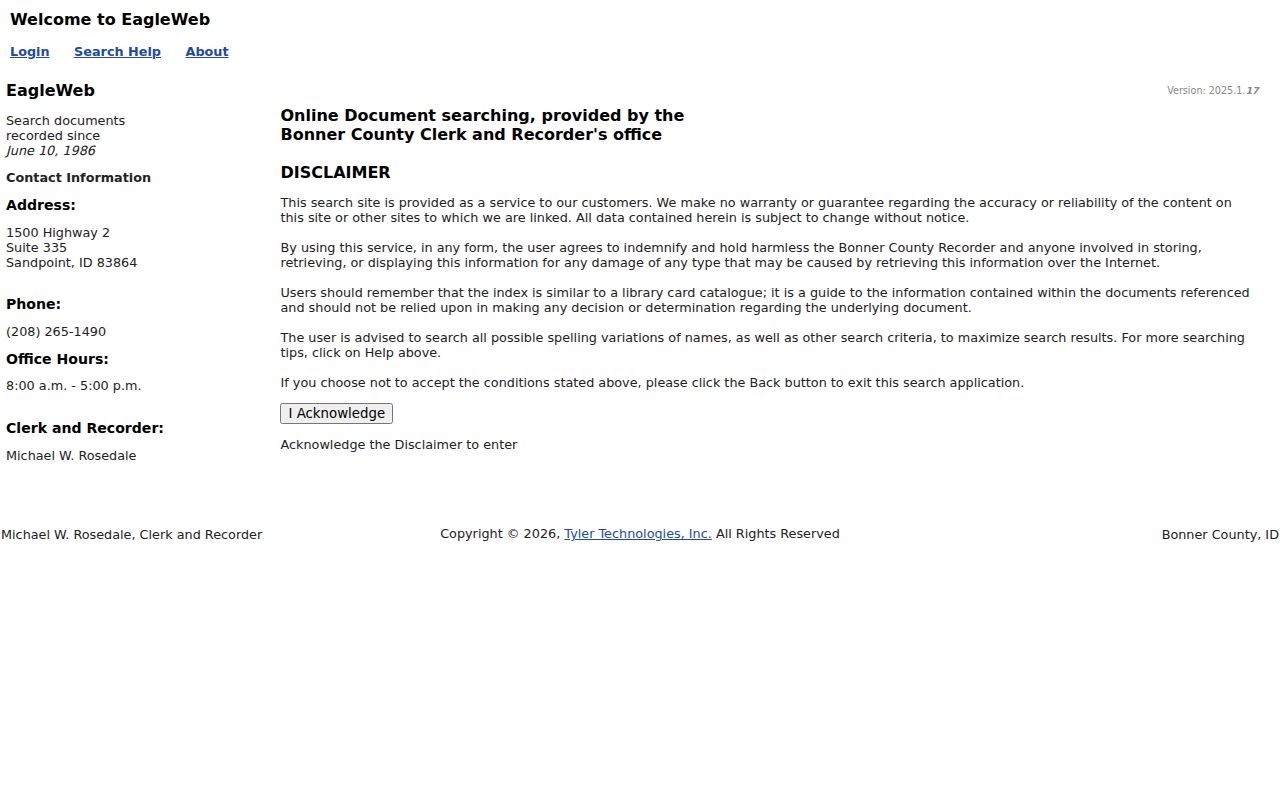
How far back the online deeds reach depends on where you look: the county document-search page says July 1, 1986, while EagleWeb says June 10, 1986. When a chain of title crosses those dates, work the web portal and the Recorder's in-office books together. Deed books from before the cutoff still exist.
Bonner County itself dates to 1907. Sandpoint's 1898 plat and 1901 incorporation are older still. Early land research may therefore reach into Kootenai County records and archival finding aids.
Coverage check. Treat the two 1986 dates as an official mismatch and ask the Recorder about the needed instrument.
Bonner County Deed Search Controls
Names drive the search. No deeds are indexed by assessor parcel number. The EagleWeb help pages document Basic and Advanced searches, so run the current grantee, the prior grantor and any entity name variants, then narrow the results with a date and a document type.
| Control | Purpose | Caution |
|---|---|---|
| Grantor | Party giving an interest | Try prior names |
| Grantee | Party receiving an interest | Trust wording varies |
| Reception number | One exact filing | Use when known |
| Document type | Separate deeds and releases | A chain spans types |
| Subdivision, block, lot | Platted land | Ranges may use 12:30 |
The official Recorder index shows the live routes.
The Bonner County Grantor-Grantee Index
Think of the grantor-grantee index as a party index. The grantor gave up an interest. The grantee received it. Start from the latest known owner, find the deed that vested that owner, then search that grantor as a grantee in an earlier acquisition, matching the legal description at every step.
- Find the current owner's acquisition deed with that owner as grantee.
- Read the grantor and exact legal description from the instrument.
- Search that grantor as an earlier grantee and match the same land.
- Move to office index books when the chain predates online coverage.
- Grantor
- The party conveying an interest.
- Grantee
- The party receiving an interest.
- Chain of title
- The sequence of instruments affecting ownership over time.
- Book/page
- A location in a bound or imaged record series.
- Reception number
- A unique reference assigned to a filing.
Find Related Bonner Deed Instruments
EagleWeb's Find Related feature connects filings through shared legal-description terms, moving from a deed to a corrective re-record, a reconveyance or a release. Treat it as a lead. Read every image. Compare parties, dates, document type, reception number and legal description before trusting the link.
A same-name hit on different land is not part of your chain. A shared clue cannot beat a conflicting legal description.
WestPointe Clues in Bonner Deeds
Sandpoint's WestPointe Place file links parcel RPS376800104A0A to a four-lot replat, Book 10 page 15, instrument 790060. City files can seed county deed leads.
Use those identifiers to pull the county instruments. A planning applicant or owner label is still not a title statement.
Bonner County Deeds and Easements
The Assessor keeps no complete easement ownership layer. Search deeds, easements, plats, surveys and releases. For access or boundary questions, pull the actual instrument and survey rather than trusting an index summary or a GIS line. The county's Land Records guidance covers deeds, legal descriptions, plats, surveys and parcel maintenance.
Bonner County Deed Costs and Channels
The Recorder takes deeds at the counter, by mail and through authorized e-recording channels. The posted schedule lists $15 for a deed under its page-count condition, $45 for a mortgage under its condition, and $1 per page for copies. Confirm current fees before sending payment. Staff will locate public records. They will not run a title search.
For older material, use the office books or send a focused request listing party names, a date range, document type, legal description and any known reference. A narrow request gets answers faster. State the grantor, grantee, recording window and land description. Say whether inspection, an uncertified copy or a certified copy fits the need.
The county public-record form can document when another office holds the records or when more time is required. It keeps a cross-office request on the record.
Bonner Deed Corrections and Releases
One deed never ends a chain. Recording guidance lays out correction procedures, and the index can hold re-recorded or corrective instruments. Compare each correction to the original. Note what changed and whether it cites the earlier reception number, keeping both filings distinct in a research note rather than silently swapping one for the other.
Mortgage releases and reconveyances answer a different question. They show that a recorded lien was later addressed. They do not convey the deed's interest. Search related document types and use Find Related as a lead, keeping the sequence of deed, security instrument and release distinct.
Tax-deed instruments run on their own statutory process in Bonner County. The county describes three years of delinquency, April publication, a May hearing, redemption timing and an auction window. Check the Treasurer's current tax-deed record. An indexed tax document is rarely the whole story.
Historic Bonner County Deed Research
Digging past the web index means moving to the bound deed books at the office. Do not guess at the gap. Bonner County was organized in 1907, so anything earlier lived under another administration. Sandpoint's original plat and its incorporation date from that Kootenai County era. Older instruments may still sit in those predecessor records. Newspaper archives, the 1909 Sandpoint Sanborn map, the county historical society, and the Idaho State Archives are all useful for pinning down a forgotten place or party name. Treat those sources as finding aids only. A map label or news item can point toward the next grantor, addition, or lot number. The deed book and the recorded plat remain the real land-record evidence. When an old spelling surfaces, keep it beside the modern parcel number and legal description. That keeps the chain traceable.
Obtain a Bonner County Deed
Pin down the deed first. EagleWeb shows each instrument's parties, recorded date, document type, and reception or book/page reference. Jot those details down. Then check whether the image is viewable online. You can also reach out to Recording for a plain or certified copy. Mail and in-person requests still matter for older books. Some pages never made it into the online system.
Recorded, not guaranteed. Bonner County deed records show filed instruments. They do not prove that no unrecorded interest, defect or competing claim exists.