
Find Out Who Owns a Bonner County Property
The parcel comes first. Before trusting any name, tie the street address to a Bonner County parcel number. The Assessor names the county's owner of record. The Recorder's latest recorded conveyance is the stronger transfer evidence. Checking both also catches address, mailing, and timing mismatches. A single search result can hide them.
- Search the address in the Bonner County Public Parcel Map and copy the parcel number and exact owner-of-record name.
- Search that grantee name in Recorder EagleWeb, then identify the newest deed tied to the legal description.
- Compare recording date, grantor, grantee, document type, and legal description. A deed can be several business days ahead of an online county card.
- If an entity holds title, use the Idaho Secretary of State filing only to understand the entity. Do not treat it as the deed.
Bonner County Owner Fields Need Careful Labels
Labels matter on a Bonner County tax bill. The sample bill separates owner mailing address from property location and legal description. The mailing address serves correspondence only, so treat the name, mailing address, situs, parcel number, and legal description as distinct fields rather than proof of where anyone lives.
- Owner of record
- The title owner shown by county public records.
- Grantee
- The party receiving an interest in a recorded conveyance.
- Situs address
- The physical property location, which may differ from the mailing address.
- Title
- The legal ownership interest, not merely a name displayed in a search result.
Bonner County Deeds Can Lead the Online Owner Card
Bonner County describes different update rhythms for different layers. GIS data may refresh nightly or daily. A newly recorded document can take several business days to appear, and the simplified property-search display warns that certain changes update only annually. None of these statements should become one universal promise about the data. When a sale is recent, check the newest recorded conveyance before deciding who owns the property. Also record the date each source was checked.
Where Bonner County Property Owner Evidence Lives
No single county portal answers every ownership question. The map and Assessor give the practical current display, and EagleWeb holds the recorded transfer trail. An entity filing can explain a business name, though it proves nothing about that entity's interest in land.
| Source | Owner Info It Gives | Access |
|---|---|---|
| Assessor and tax record | Owner of record, mailing, situs, parcel and value context | County property material and office terminal |
| Recorder EagleWeb | Grantor, grantee, date, instrument, and document type | Name-and-date index; online from June or July 1986 |
| Idaho Business Search | Entity filing, agent, and addresses | State search |
| Public parcel map | Mapped parcel and primary owner-information route | Free GIS viewer |
The owner of record may be a person, trust, estate, or entity. An occupant or permit applicant may be someone else entirely. A mailing address or an application signature does not prove title. The county's official property-search entry page is the natural starting point for this method. Open the live Bonner County page for current directions.
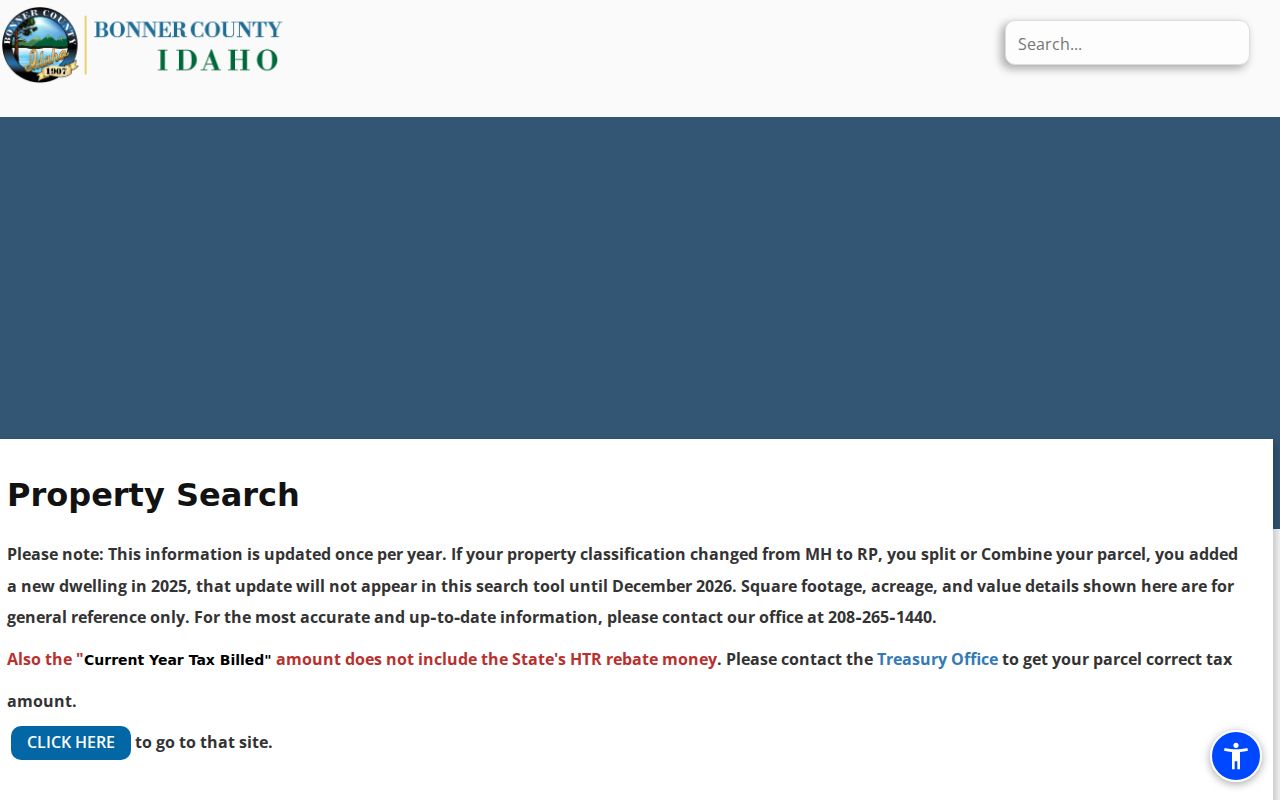
The screenshot shows the official route, while deed confirmation remains a separate Recorder step.
Trace a Bonner County Owner with the Legal Description
Rural addresses, postal-city labels, replats, and parcel splits can all make an address ambiguous. The legal description is what carries continuity through those changes. For a platted lot, search subdivision, block, and lot in EagleWeb. For other land, keep the full section or metes-and-bounds text intact. EagleWeb indexes by name and date, not by parcel. So try spelling variants, and use its subdivision fields or Find Related function when a referenced instrument or shared description bridges the gap.
A Marriage License Does Not Change Bonner County Title
A marriage license changes nothing on title. The Assessor's guidance is clear on this point. A deed or qualifying affidavit must be recorded to move ownership. The local rule prevents a common mistake. That happens when a surname changes or a spouse appears in another public file. A probate filing, tax bill, or court docket can support the evidence. But none replaces the recorded transfer instrument. So use the office that holds each record.
Ask Bonner County Offices When the Owner Trail Breaks
The Recorder sits at 1500 Highway 2, Suite 335, in Sandpoint. Public hours run 8 a.m. to 5 p.m., and recording ends at 4:30 p.m. The Assessor is in Suite 205. Its public-terminal information lists 9 a.m. to 5 p.m. Bring names, dates, a parcel number, and the legal description. Staff can demonstrate search methods. They will not perform a title search or interpret ownership. A focused Idaho Public Records Act request can reach a named file. Use it when the online route does not expose it.
What a Bonner County Owner Lookup Cannot Prove
A public display has limits. It can identify a recorded or assessed owner, yet it cannot prove occupancy, reveal every beneficial interest behind a trust, or confirm a title free of easements and liens. Idaho's Address Confidentiality Program also supplies substitute-address protection for qualifying people facing danger.
Lawful use. Use Bonner County owner information for legitimate property research, purchase diligence, estate work, or boundary questions. Never use it to target or harass a person.
The owner of record is only half the picture. For a detailed present-owner record, continue to the current Bonner County owner guide, and leave prior ownership to the deed-chain workflow.
Use a Focused Bonner County Records Request as Fallback
A needed file is not always online. Send the request to the department that holds it. The county form permits inspection or copies, with delivery by pickup, mail, or fax. A response may grant access or ask for clarification. It may also require advance payment, name another custodian, delay production, or withhold protected material. Idaho Public Records Act guidance favors a specific description. Name the parcel. Give the instrument or project number. List the file type, the parties, the date range, and the format you want. The county describes a response within three working days. Otherwise, it sends a notice that up to ten working days is needed. State guidance carries separate timing provisions for nonresidents. A focused request can bridge a missing planning file or assessment document. It should not ask the office to decide who owns the parcel. Preserve whatever records arrive, then apply the same Assessor-to-deed confirmation method.
Stop a Bonner County Owner Search at the Right Boundary
The Recorder files deeds, mortgages, releases, easements, plats, surveys, and liens under Idaho law. Staff will not draft deeds or hand out legal advice. GIS and Assessor maps are not surveys, the county says. Those limits matter once a Bonner County property search turns up a conflict.
Overlapping deeds, an easement that blocks the intended use, or a murky trust interest all call for the same response. Save the instrument images. Bring them to a title professional or attorney. A directory result cannot settle competing claims. Treat Bonner County property records as a way to spot evidence and frame a precise question, not as a title opinion.
Read Bonner County Trust and Entity Owners in Two Stages
An owner card sometimes names an LLC, a corporation, or a trust. Copy the grantee text exactly as recorded. EagleWeb comes first. The deed records there show which legal interest passed. The Idaho Business Search can then supply a filing, registered agent, or filing address. That helps identify the organization.
That state filing is an identity aid, not land evidence. An agent listed on the record does not become the property owner. A trust name may hide its beneficiaries. The trail can stop at the trustee or the recorded instrument.
Estates deserve the same care in Bonner County. Probate orders, affidavits, and personal-representative deeds often explain a transfer after death. Pair the court file with the eventual recorded document. Never assume the estate filing itself changed title that day.
Save a Bonner County Owner Lookup Worksheet
A worksheet keeps any Bonner County owner lookup honest. Record the address you typed, the mapped parcel number, the legal description, the displayed owner of record, the mailing address, the card's update date, and the newest deed that matters. From the index, add grantor, grantee, recording date, reception number, and document type. If no update date appears, label the gap. Guessing is worse. Save the page or instrument citation so anyone can retrace the deed records.
Two sources will sometimes disagree. Do not quietly pick one. Mark the difference first. Check spelling and parcel identity, then weigh recording lag, a corrective instrument, a split, a replat, or a mailing-only change. That discipline makes the answer to who owns the property traceable rather than a guess.
Leave private details out of your notes. Ownership research targets the parcel and its recorded interests, never a profile of the people tied to an address.