
Fields Inside Bonner County Property Tax Records
Two files sit behind Bonner County property tax records. The Assessor keeps the annual valuation record. The Treasurer keeps the bill and the payment history. The county's redacted sample bill is the clearest map of what a notice contains. It labels the property location, legal description, parcel number, and owner mailing address. Then it shows the land value, improvement value, total market value, homeowner exemption, and net market value. Levy components, special charges, and the Idaho homeowner-tax-relief reduction appear as well. Each field answers its own question. None of them should be collapsed into a single number.
| Field | What It Shows | Where |
|---|---|---|
| Land and improvements | Separate components of the county's current market valuation | Assessor record and tax bill |
| Total market value | County valuation before displayed reductions | Assessment notice and bill |
| Exemptions and net market | Reductions shown for an eligible property and the remaining value | Assessor and sample bill |
| Tax bill and balance | Levies, special charges, relief, amount due, and payment status | Treasurer |
| Tax-code area | The set of taxing jurisdictions used on that parcel's bill | Treasurer bill |
That value is not a sale forecast. A deed may carry separate consideration evidence, and an appraisal answers a different question at a specific date. To keep those distinctions straight, the Bonner County property value guide explains what each number actually means.
Bonner County Tax Bills Separate the Address and Owner Mail
A Bonner County tax bill can list one address for the land. It can list another for mail. That split proves nothing about where the owner lives. It simply lets the Treasurer deliver the notice. The account stays tied to the parcel and its legal description.
For an account-specific balance or bill question, the Bonner County Treasurer is the source. Valuation and exemption questions go to the Assessor. Keeping that division straight matters. A payment screen should never be mistaken for a full property tax search.
Bonner County Property Tax Dates Run in Two Installments
The county tax year runs January 1 through December 31. Notices go out by the fourth Monday in November. Full payment, or the first half, is due December 20. The second half comes due June 20. A deadline can land near a weekend. A parcel can also carry a delinquency. Owners should confirm the current calendar with the Treasurer.
Payment screen. The GovPros form collects payment details and adds a vendor service fee; it is not the county tax-roll lookup.
The county's payment page handles transactions only. Its role stays narrow by design, and a taxpayer should understand that before entering payment information.
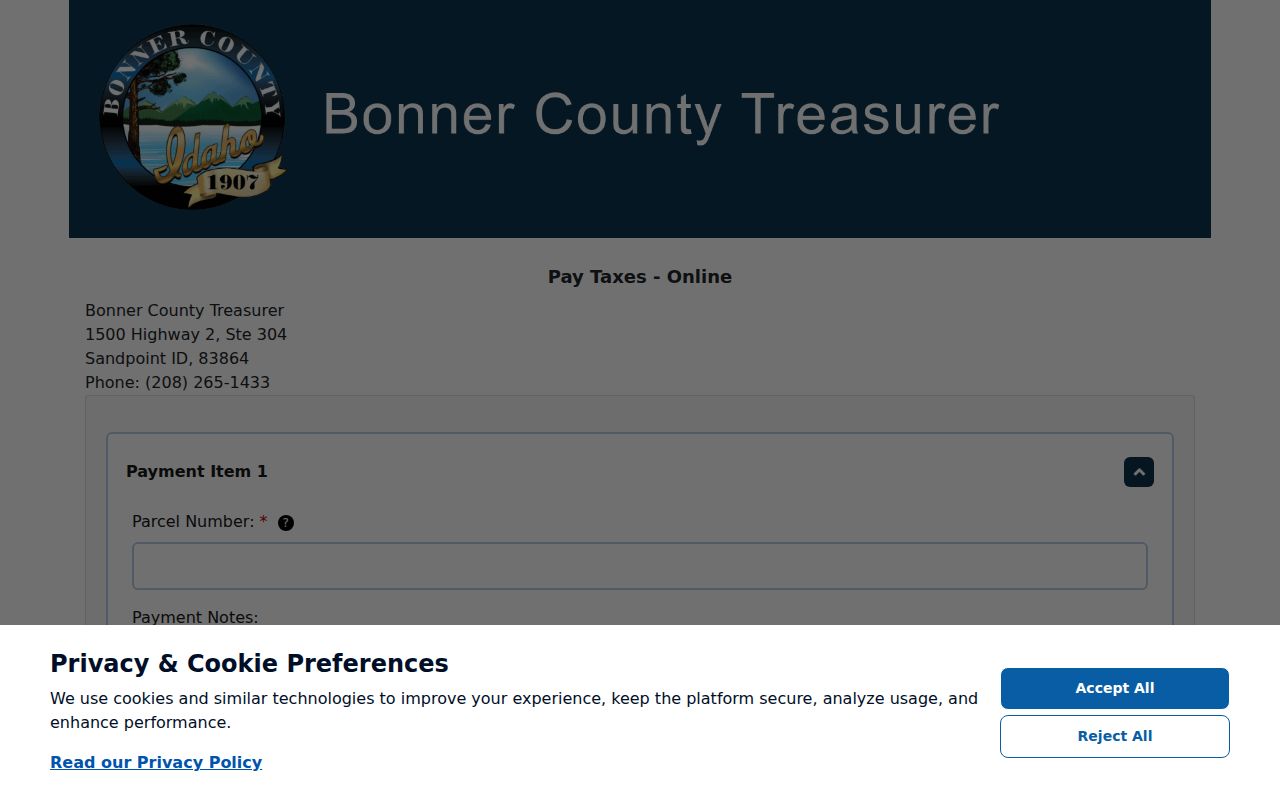
That screen transmits a payment and may add a service fee. Parcel research and balance confirmation still belong with the county's own records.
Bonner County Exemptions Change Net Value, Not the Ratio
The homeowner exemption is a statutory reduction for an eligible primary residence. It is not a blanket discount ratio applied to every parcel. Idaho's assessment-ratio studies compare assessments with market evidence. That work supports equalization across parcels. The studies do not promise one fixed percentage for a specific home.
For 2026, the Assessor announced a December 31 homeowner-exemption deadline. Eligibility and the correct application should be confirmed through the Bonner County Assessor. The exemption and the assessment record both live there. The result simply shows up later on the tax bill.
Bonner County Assessment Notices Come Before Tax Bills
An assessment notice states the Assessor's market value. The Assessor placed that value on the property for the current year. A tax bill follows later, after taxing districts set their budgets and levies. A challenge to a market-value conclusion belongs in the assessment review period. Payment and balance questions belong with the Treasurer.
The Assessor builds annual valuations from cost information and sales. Personal visits also shape the numbers. Material from owners and real-estate professionals feeds the annual valuations too. Strong review evidence can include a recent appraisal or a comparable-market analysis. Photographs, repair estimates, and accurate facts about the parcel's condition also help.
Check a Bonner County Property Tax Account
A reliable Bonner County property tax lookup starts with the parcel, not the payment vendor. The public parcel map and Assessor material establish the parcel number. They also establish the current valuation context. The Treasurer then confirms the bill itself. Balance, payment history, delinquency, and account-specific issues all stay with that office.
- Find the address in the Bonner County Public Parcel Map and copy the full parcel number and legal description.
- Compare land, improvement, total market, exemption, and net market fields on the Assessor record or assessment notice.
- Ask the Treasurer to confirm the current bill, earlier years, payment status, and any delinquent amount for that parcel.
- Read levy components and special charges separately, then save the bill year and date checked.
- Current market value
- The Assessor's annual estimate before exemptions shown on the bill.
- Levy
- The rates and district charges applied in producing the tax amount.
- Homeowner exemption
- A reduction available to a qualifying primary residence.
- Tax lien
- A public claim arising from unpaid property tax, distinct from ownership itself.
Bonner County Delinquency Has a Public Notice Trail
Unpaid taxes can grow into a tax-deed process. A late balance is not an immediate ownership change. The county materials list four weekly April publications in the Daily Bee. Those notices are part of the tax-deed notice calendar. The Treasurer remains the source for actual status and the cure amount.
Careful documentation pays off here. Preserve the parcel number, tax year, publication dates, notices, and any later recorded instrument. Court or Recorder records may matter if a dispute or transfer follows. Property tax records alone do not establish a complete title chain.
Bonner County Corrected Some 2026 Business Notices
The Assessor's June 2026 news reported a statewide system error affecting business-personal-property notices. Corrected notices were to be mailed. The episode is a useful local example of why a notice's date and version matter. A surprising notice should be compared with the latest official communication. Do not use it as evidence before that check.
The correction changed no office roles. It did not turn the payment vendor into a tax database. It was a notice issue, handled through the Assessor's published update.
Note: Keep both the original and corrected notice when documenting a Bonner County property tax question.
Contest a Bonner County Property Assessment on Time
Bonner County gives owners one narrow window each year to contest an assessment. In 2026, the Assessor announced notices by June 1. The inquiry period ran through June 22. The appeal deadline was 5 p.m. that same day. The window moves from year to year. Rely on the current notice and the county's own forms. They control over any summary of past calendars.
Appeal window. The 2026 Bonner County deadline was June 22 at 5 p.m.; verify the current year's fourth-Monday-in-June date before filing with the Board of Equalization.
An appeal is about market value alone. Dissatisfaction with tax rates or district budgets has no place in it. Start with the Assessor during the inquiry period. Point out any factual errors. Back the claim with evidence on the required appeal form. The assessment notices and appeals page is the official starting point. The county Assessor page is linked from that source. It lays out the assessment-notice route in the county's own words.
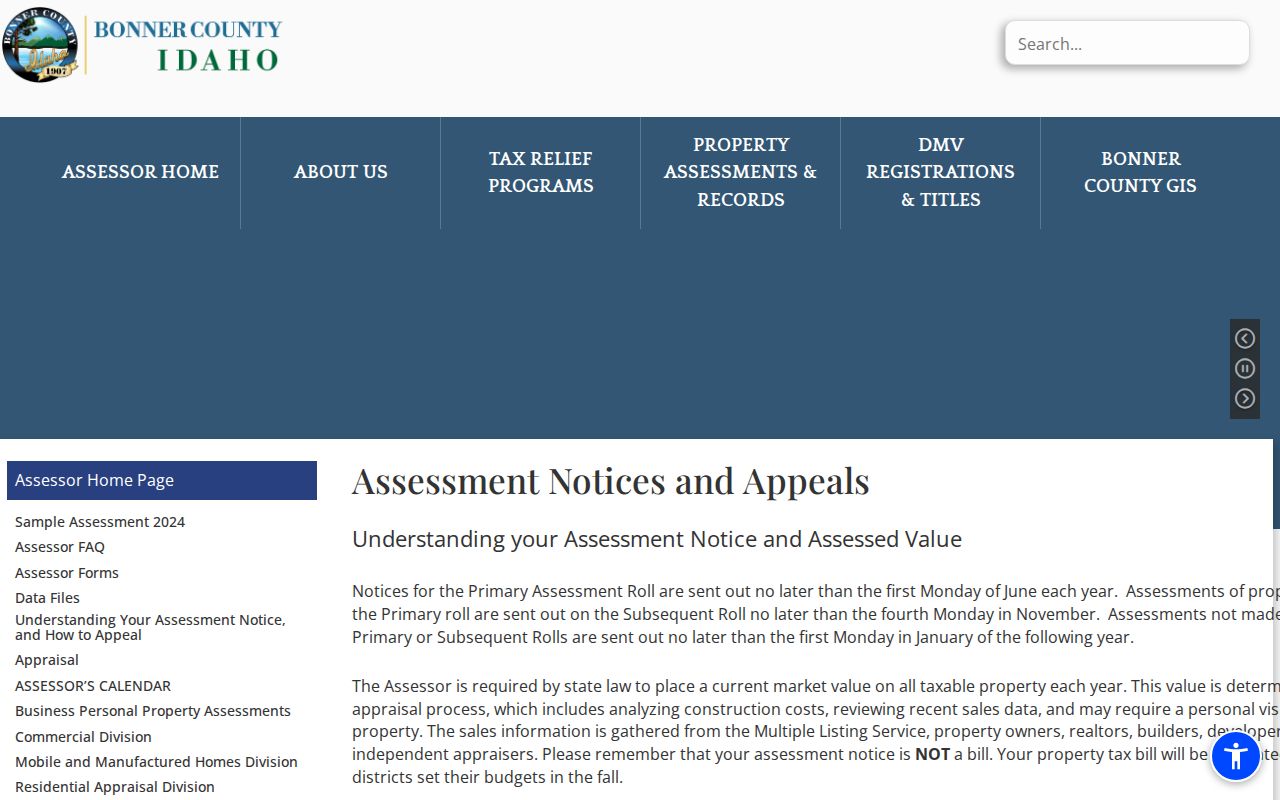
Treat the guide as a map of the process only. It is not a parcel-specific valuation, so the owner still needs the actual notice and supporting evidence.
Route Bonner County Property Tax Questions by Record Type
Each Bonner County office answers a different slice of the tax record. The Assessor maintains ownership, parcel characteristics, classification, exemptions, and the annual value. The Treasurer collects the tax and confirms bills, balances, due dates, delinquency, and payment. The Recorder holds deeds and recorded liens. The Clerk of Court handles litigation, not land-document indexing. All three desks sit at 1500 Highway 2 in Sandpoint. The Assessor is in Suite 205. The Treasurer is in Suite 304. The Recording Department is in Suite 335. The Recorder's public day runs 8 a.m. to 5 p.m. Recording stops at 4:30 p.m. Assessor terminal guidance lists 9 a.m. to 5 p.m. Bring the exact parcel number, the legal description, the owner name, and the tax year. State the question plainly. That keeps a value issue from landing with the payment vendor. It also stops a title issue from being guessed off a bill. County staff can explain their records, though they will not perform a title search.
Keep a Bonner County Tax Evidence Log
A good evidence file pairs every figure with its source and year. Note the parcel number and owner mailing name. Note the situs, tax-code area, land value, improvements, and total market value. Also record the exemption, net market, levy items, special charges, relief, and payment status. If a corrected notice arrives, file both versions and mark which one controls. Never copy a balance without its retrieval date. Payments and added charges can shift the account, while an old saved page keeps circulating. Ask the Treasurer for confirmation when the record will support a sale closing, estate accounting, or tax-deed inquiry. For title work, add the latest deed and any recorded lien or release as separate items. A tax bill's owner display helps with routing. It does not certify the chain. Keeping these strands separate makes Bonner County property tax records far easier to explain and reproduce. When comparing years, keep the tax-code area and exemption status beside each value. A changed total may trace to a levy or a special charge. It may also trace to relief, an exemption, or a reassessment. The total alone cannot show which part moved. If land was split or combined, retain both the parent and new parcel identifiers. That way the comparison tracks the same property.